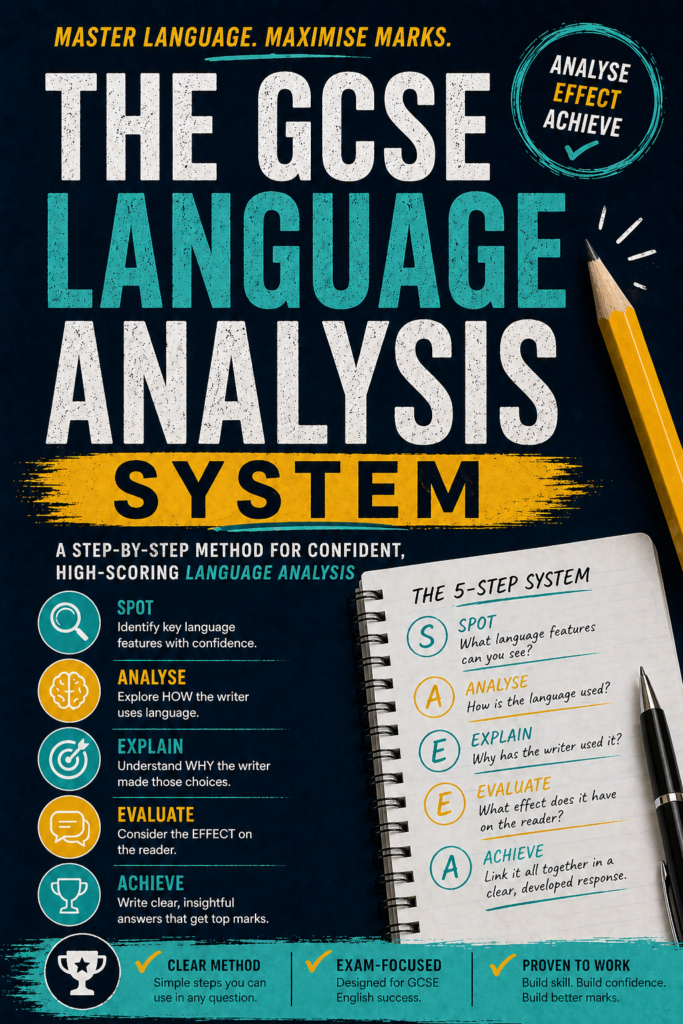
The Language Analysis System
A complete toolkit for high-scoring language analysis
| Who is this for? GCSE students who can find techniques but don’t know how to analyse them at Grade 7–9 level. Students whose essays are technically correct but analytically thin. Anyone who wants to understand WHY language analysis matters, not just how to perform it Students preparing for English Literature, English Language, or both. Homeschooled students who need a complete, self-contained language analysis course. Year 10 students who want to build strong habits before the pressure of Year 11. |
What’s in the guide:
| Chapter | Content |
| Introduction | What language analysis actually is and why it separates grade boundaries |
| Chapter 1: The Analysis Pyramid | The four levels (identification, explanation, effect, significance) with the same quotation analysed at all four levels |
| Chapter 2: Figurative Language | Metaphor, extended metaphor, simile, personification, symbolism — each with definition, the analytical questions to ask, worked examples, and grade-level models |
| Chapter 3: Sound, Rhythm & Form | Alliteration, sibilance, assonance, onomatopoeia, caesura, enjambment, rhyme, rhythm — with consonant sound guide and effect tables |
| Chapter 4: Tone, Voice & Mood | How to analyse tone, the three-step formula, an 80-word tone bank with example usage, tone shift analysis |
| Chapter 5: Structural Analysis | Juxtaposition, circular structure, withholding, opening and closing, volta — with worked examples from GCSE texts |
| Chapter 6: The Word-Level Zoom | Denotation vs connotation, register, parts of speech analysis, how to choose which word to zoom into |
| Chapter 7: Prose | Prose-specific techniques, the analysis sequence, a full Grade 9 worked analysis of A Christmas Carol |
| Chapter 8: Poetry | Poetry analysis priority order, the six most common mistakes, a full Grade 9 worked analysis of Ozymandias |
| Chapter 9: Drama | Drama-specific techniques, the double-voiced analysis formula, a full Grade 9 worked analysis of An Inspector Calls |
| Chapter 10: Sentence Bank | 100 analysis sentence starters across six categories: technique introduction, word zoom, tone, structure, writer’s purpose, comparison |
| Bonus 1 | Complete quick-reference card for the whole system |
| Bonus 2 | The 10 most impactful analysis habits with grade impact rating |
| Bonus 3 | The Grade 9 analysis checklist (20 items) |
| Bonus 4 | Complete technique glossary — 21 techniques with definition and analytical question |
| Bonus 5 | 10 fully annotated Grade 9 model paragraphs across different texts |
| Get The Language Analysis System £9.99 One-time payment • Instant download • Yours to keep 10 chapters + 5 bonus resources • Word document format • Print-ready For all GCSE English exam boards • Literature and Language • All year groups 14-day satisfaction guarantee. If this guide doesn’t improve your analysis, we’ll refund you in full. |
| Question | Answer |
| What format? | Fully formatted Word document (.docx). Opens in Microsoft Word, Google Docs, or any standard word processor. Print-ready throughout. |
| Literature or Language? | Both. The system applies equally to both papers. Chapter 7 (prose), Chapter 8 (poetry), and Chapter 9 (drama) cover Literature texts. The word-level zoom, tone analysis, and sentence bank apply directly to Language analysis questions. |
| Is this different from the Rescue Kits? | Yes. The Rescue Kits are text-specific revision tools. This is a transferable analytical system you apply to any text you encounter. Together they are complementary: the Rescue Kits provide the content; this guide provides the method. |
| Which year group? | Year 10 is the ideal time to build these habits. Year 11 students can use it immediately. The guide is also suitable for high-attaining Year 9 students beginning GCSE English. |
Analyse the choice. Explain the effect. Argue the significance.
The Language Analysis System — £9.99 • Instant download
© GCSE Study Guides • For personal and homeschool use
