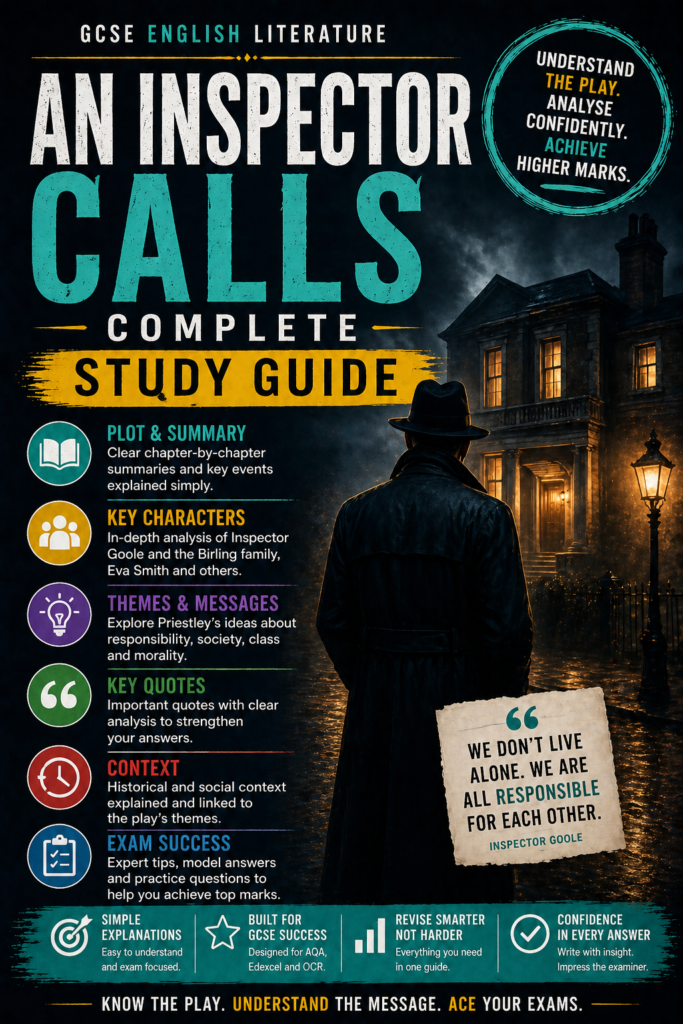
An Inspector Calls
Complete Study Guide
FOR GCSE STUDENTS AGED 13–18 • ALL ABILITIES • PLAIN ENGLISH THROUGHOUT
It’s not a detective play. It’s a political play disguised as one.
Most students know it’s about responsibility and class.
Very few know how to write about it at the level the exam requires.
About this guide
Understanding the difference between knowing the play and knowing how to write about it
The difference between a Grade 5 and a Grade 9 on An Inspector Calls is rarely plot knowledge. It’s understanding the 1912/1945 gap as the play’s central dramatic device, the Inspector as a construct rather than a character, Priestley’s socialist argument, and how every word choice serves that argument. This guide teaches all of that in plain English, for students of all abilities.
It shows you exactly what the examiner wants to see — and how to give it to them.
The thing most students miss
Priestley wrote the play in 1945 and set it in 1912 deliberately. His audience had lived through two World Wars that Birling — in 1912 — confidently predicted would never happen. Every prediction Birling makes in Act 1 is historically wrong, and Priestley’s audience knew it. Understanding that gap is the key to understanding why the play works the way it does.
Political depth
Priestley’s socialist argument explained clearly — and how it shapes every dramatic choice in the play.
Dramatic technique
The Inspector as device. Dramatic irony at three levels. Lighting. The single setting. The circular structure.
Exam-focused
Every section connects to what AQA rewards. Grade 4, 6, and 9 model responses on two questions.
What’s in the guide
Act by act, theme by theme, technique by technique
Every act is covered in detail — key scenes, quotation analysis, dramatic technique, and context for each.
Context — five sections connecting directly to the text
The 1912 class system, the 1912/1945 gap as the play’s central device, Birling’s predictions as dramatic irony, social class and the welfare state, gender in 1912. All five connect directly to the text — context as analysis, not background for its own sake.
Dramatic technique — Priestley’s tools
Naturalistic drama and how Priestley breaks it. Dramatic irony at three levels. The Inspector as a dramatic device, not a character. Lighting and stage directions. The single setting. The circular structure. How all of these serve one political argument.
Structure — the play’s design
The well-made play with a twist. The deliberate order of revelations — from economic exploitation to physical. The circular ending and what it means. Act by act structural breakdown.
The Inspector in depth
What makes him dramatically unusual. His interrogation method. His language — precision vs the Birlings’ evasion. Why he speaks to the audience, not just the characters. The Goole/ghoul ambiguity and what it means analytically.
Sheila in depth — Priestley’s argument made human
Sheila at the start vs Sheila at the end. Her growing insight through Act 2. Her refusal to return to normal in Act 3. Why Sheila is the character Priestley needs the audience to become.
Act 1 in detail
The opening world of comfortable self-satisfaction. Birling’s speech and why every prediction is wrong. The Inspector’s arrival as disruption. Birling’s firing of Eva. The first revelation — and how Priestley engineers each one.
Act 2 in detail
Gerald’s nuanced case. Mrs Birling’s use of institutional power. The trap that closes on Mrs Birling as she condemns her own son without knowing it. The end of Act 2 — Priestley’s most precise piece of structural irony.
Act 3 in detail
Eric’s raw confession. The Inspector’s final speech. The generational split between those who accept responsibility and those who retreat from it. The attempt to return to normal. The phone call that ends the play — and why it matters.
All major characters with card summaries
Inspector Goole, Mr Birling, Mrs Birling, Sheila, Eric, Gerald, Eva Smith. For each: role, key quotation, character traits, and dramatic purpose — plus exam phrases to use in your essays.
Six themes in depth
Social responsibility, class and power, gender, older vs younger generation, guilt and responsibility, time and history. Each with quotations, analysis, and specific exam guidance on how to approach the question.
Language and setting
The Inspector’s precision vs the Birlings’ evasion. Dramatic irony at three levels. The dining room as symbol. Eva Smith’s absence as a political statement — and how to write about it analytically.
Top 30 quotations — with key word to zoom into
Every major quotation in a table: who says it, which act, which themes it connects to, and the specific word to analyse. The fastest and most targeted revision tool in the guide.
Grade 4, 6, and 9 examples on two questions
Grade 4 on Act 1, Grade 6 and Grade 9 full responses on responsibility — with detailed mark-scheme commentary on what each response does and exactly what needs to change to move up.
Quick revision card — everything on one page
Key facts, six themes, dramatic techniques, five must-know quotations. Print it and use it the night before the exam.
The thing most exam responses get wrong
The Inspector is not a character. He is a dramatic device.
Most students write about the Inspector as if he is a real police officer — analysing his personality and motivation. The highest-scoring responses understand that Priestley constructed the Inspector to do a specific job: to be the voice of collective social conscience, to expose hypocrisy, and to speak directly to the audience over the heads of the Birlings.
The name is a clue: Goole sounds like ghoul. He has no official record. He vanishes without explanation. He may be a ghost, a conscience, or an allegory for the consequences of indifference. Writing about what Priestley achieves through the Inspector — rather than what the Inspector does — is the move that separates Grade 6 from Grade 9.
What the grade examples show you
The responses at Grade 4, 6, and 9 answer the same question, so you can see exactly what changes at each level. The mark-scheme commentary explains why each move earns marks and what you need to add to move up.
Relevant points, some quotation use. Understands what happens but writes about characters as real people rather than dramatic constructs.
Clearer argument, explains quotations and their effect. Beginning to write about Priestley’s choices rather than just the characters’ behaviour.
Every analytical point connects to Priestley’s political argument. The Inspector treated as device. Word-level precision. Context woven into analysis.
Everything included
Nothing left out
The complete contents of the guide:
Get the guide
One purchase. No subscription. Yours to keep.
An Inspector Calls Complete Study Guide
AQA GCSE English Literature
- Complete study guide — context, technique, structure, all three acts, six themes, language
- The Inspector in depth + Sheila in depth — the two characters that matter most for the exam
- Top 30 quotations with key word to zoom into for each
- Grade 4, 6, and 9 responses on two questions — with mark-scheme commentary
- Quick revision card — printable one-page summary
- Word document (.docx) — opens in Word, Google Docs, or any standard word processor
- Fully print-ready throughout
- Instant download — available immediately after purchase
- Yours to keep with no time limit
14-day satisfaction guarantee. If the guide doesn’t help, we’ll refund you in full.
Questions
Frequently asked questions
What format does it come in?
A fully formatted Word document (.docx). It opens in Microsoft Word, Google Docs, Apple Pages, or any standard word processor. It’s fully print-ready throughout.
Is this only for AQA students?
It’s written and aligned specifically for AQA, which is the most widely used board for An Inspector Calls. The analytical skills, quotation analysis, and exam technique guidance apply across all boards — but the grade descriptors, question formats, and mark scheme commentary are AQA-specific.
How is this different from the Exam Rescue Kit?
The Exam Rescue Kit (£6.99) is a fast-revision tool built around key quotations, model paragraphs, and exam technique — ideal for the week before the exam. This Complete Study Guide (£22) is a full course resource covering context, structure, every act in detail, six themes, and all major characters with significantly more depth. Many students use both: the guide throughout Year 10 and 11, the kit in the final week.
Is it suitable for independent or homeschooled students?
Yes — fully self-contained. Everything is explained within the guide itself, with no assumed prior teaching. Homeschooled students and private candidates work through it independently without needing teacher support.
What does the members’ price apply to?
Members of quiethelpgcse.com pay £15 for this guide instead of £22. If you’re not yet a member, you can purchase at the standard price — or explore the membership for access to all guides at the reduced rate.
Complete Literature Bundle
All eight study guides + Essay Writing for Literature
Every major AQA Literature text and the essay skills to write about all of them — together for £51 less than buying separately.
It’s not a detective play.
It’s a political play disguised as one.
An Inspector Calls Complete Study Guide • £22 • Members £15 • Download immediately
Download the Guide — £22